Jordan Wolfson – The Biomechanics of Provocation and the Clinical Dissection of the Modern Psyche
Often dismissed by critics as a mere provocateur relying on shock value, Jordan Wolfson is arguably the most misunderstood artist of his generation. Through hyper-advanced industrial animatronics and virtual reality, he conducts a cold, clinical dissection of the darkest human impulses, utilizing mechanical engineering to reflect the profound numbness and violence of the digital age.
Editorial Desk
There is a distinct pathology to the way the contemporary art world digests the work of Jordan Wolfson. He is undeniably one of the most famous, institutionally supported, and commercially successful artists of the 21st century, yet he is routinely met with visceral revulsion by art critics. He is frequently labeled a cynic, a troll, or a purveyor of gratuitous trauma. However, to dismiss Wolfson as a mere shock artist is to fundamentally misunderstand the nature of his practice. Wolfson is not a moralist attempting to teach a lesson, nor is he a sadist. He is a clinician. His work is a highly engineered, frictionless mirror held up to the most repulsive, suppressed, and violent aspects of the collective human shadow.
Born in 1980 in New York, Wolfson operates at the bleeding edge where fine art intersects with industrial robotics, digital animation, and psychological warfare. His breakthrough into the global consciousness arrived with Female Figure (2014), an animatronic sculpture of a scantily clad woman in a witch mask, covered in dirt and dancing sensually to pop music. The clinical brilliance of the piece did not lie in the sculpture’s appearance, but in its optics. Equipped with advanced facial recognition technology hidden behind the mask, the animatronic locked eyes with viewers as they moved around the room. It broke the fundamental rule of museum viewing: the art was observing the spectator. The technological precision of the eye contact induced a chilling, visceral discomfort—a profound uncanny valley where human empathy was simultaneously triggered and ruthlessly short-circuited by a machine.
Wolfson’s misunderstanding stems from a modern audience's demand that art must provide a safe space or a clear moral compass. When viewers are confronted with violence or degradation in a gallery, they expect the artist to signal that they are "against" it. Wolfson categorically refuses to provide this ethical scaffolding. He acts instead like an algorithm or a search engine, presenting the raw, unvarnished data of our worst impulses without commentary. This clinical detachment infuriates a public desperate for reassurance, making him a lightning rod for cultural anxieties.
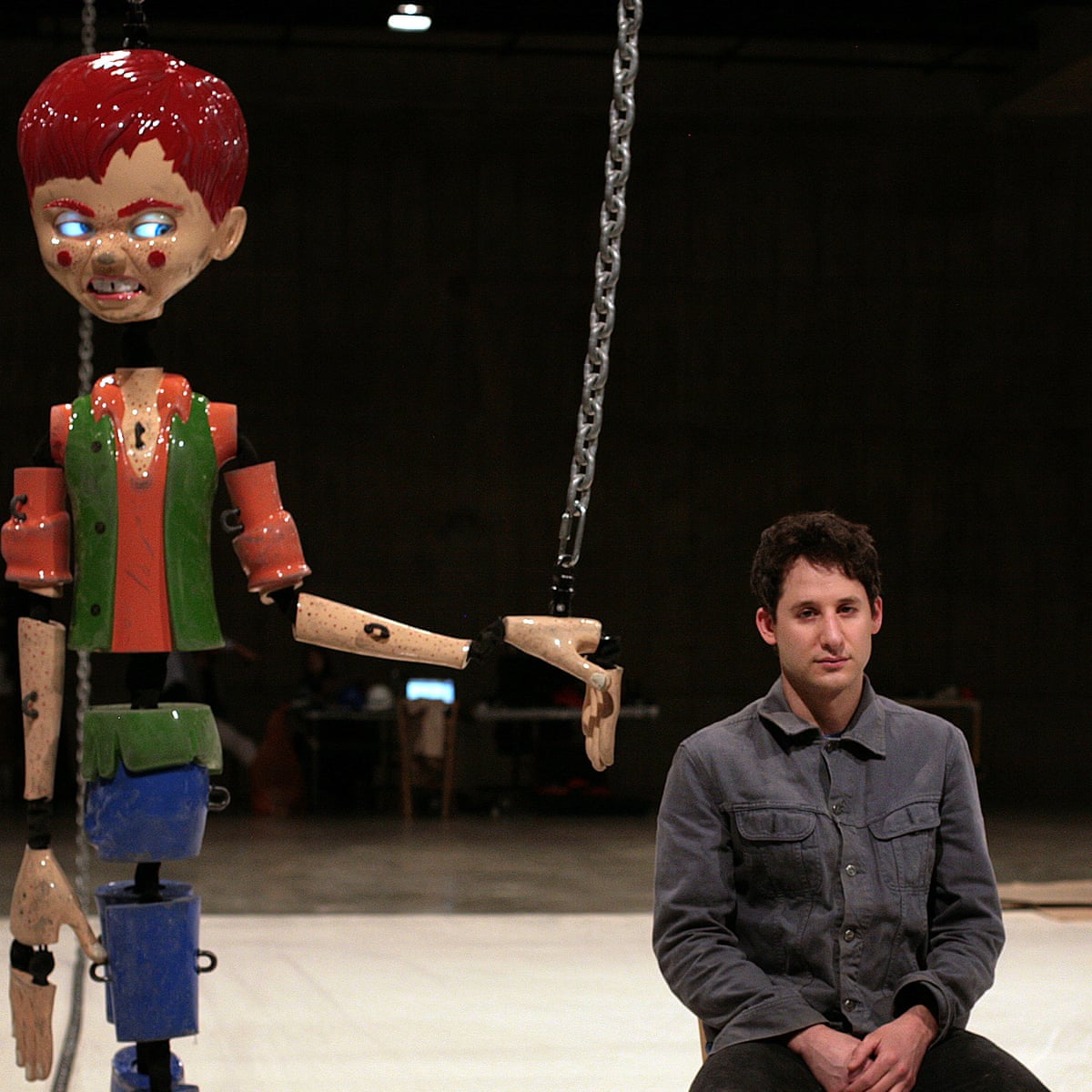
This industrial detachment reached its zenith with Colored Sculpture (2016). Suspended from a massive, heavy-duty steel gantry framework, an animatronic boy resembling a cross between Huckleberry Finn and Alfred E. Neuman is violently dragged, dropped, and suspended by heavy metal chains. The mechanics of the piece are brutal and overwhelmingly loud. The chains clank with deafening industrial force as the robotic boy is slammed repeatedly into the gallery floor, its programmable LED eyes locking onto the audience while it suffers this endless mechanical loop of abuse. It is an exploration of automated cruelty. The heavy industrial machinery, the precise computer-controlled winches, and the metallic noise create an environment that feels more like a hostile manufacturing plant than a white-cube gallery. It is a masterpiece of sensory overload, tapping into a dark, mechanical aesthetic that strips away human warmth and leaves only cold, calculated physics.
In 2017, Wolfson further alienated his detractors and solidified his genius with Real Violence, a Virtual Reality installation debuted at the Whitney Biennial. Viewers strapped on a VR headset and were immediately placed on a sunlit New York street. In crisp, high-definition 3D, they watched a digital avatar of Wolfson himself brutally beat another man to a bloody pulp with a baseball bat. The audio track featured Wolfson calmly reciting a Hebrew Chanukah prayer over the sounds of the assault. The clinical nature of the piece lay in its complete lack of narrative justification. There was no context, no backstory, and no resolution. By placing the viewer in a fixed position where they could neither intervene nor look away without actively removing the headset, Wolfson weaponized the VR medium. He forced the audience to confront their own complicity and the totalizing numbness with which we consume horrific violence daily through the glowing screens of our devices.
For the serious collector, Jordan Wolfson represents a highly complex but historically vital acquisition. Represented by the mega-gallery David Zwirner and heavily collected by institutions like The Broad in Los Angeles and the Stedelijk Museum in Amsterdam, his market weight is undeniable. Yet, owning a Wolfson is not like owning a decorative painting; it is the acquisition of an industrial machine designed to challenge the very architecture of the space it inhabits. Collectors who acquire his digital videos, holographic installations, or smaller robotic works are buying into a rigorous, uncompromising documentation of contemporary American psychosis.
Wolfson’s art is difficult because the reality he models is difficult. He understands that in an era dominated by algorithmic feeds, hyper-surveillance, and normalized digital violence, traditional figurative painting or polite conceptualism is often insufficient to capture the true frequency of the zeitgeist. He uses the tools of our alienation—robotics, VR, CGI, and industrial automation—to map the void. To engage with Jordan Wolfson is to step into a clinical laboratory of the human condition, a place devoid of comfort, but rich with the terrifying, undeniable truth of what we have become.
Curated Publications
Essential monographs and criticism, selected by our editors.